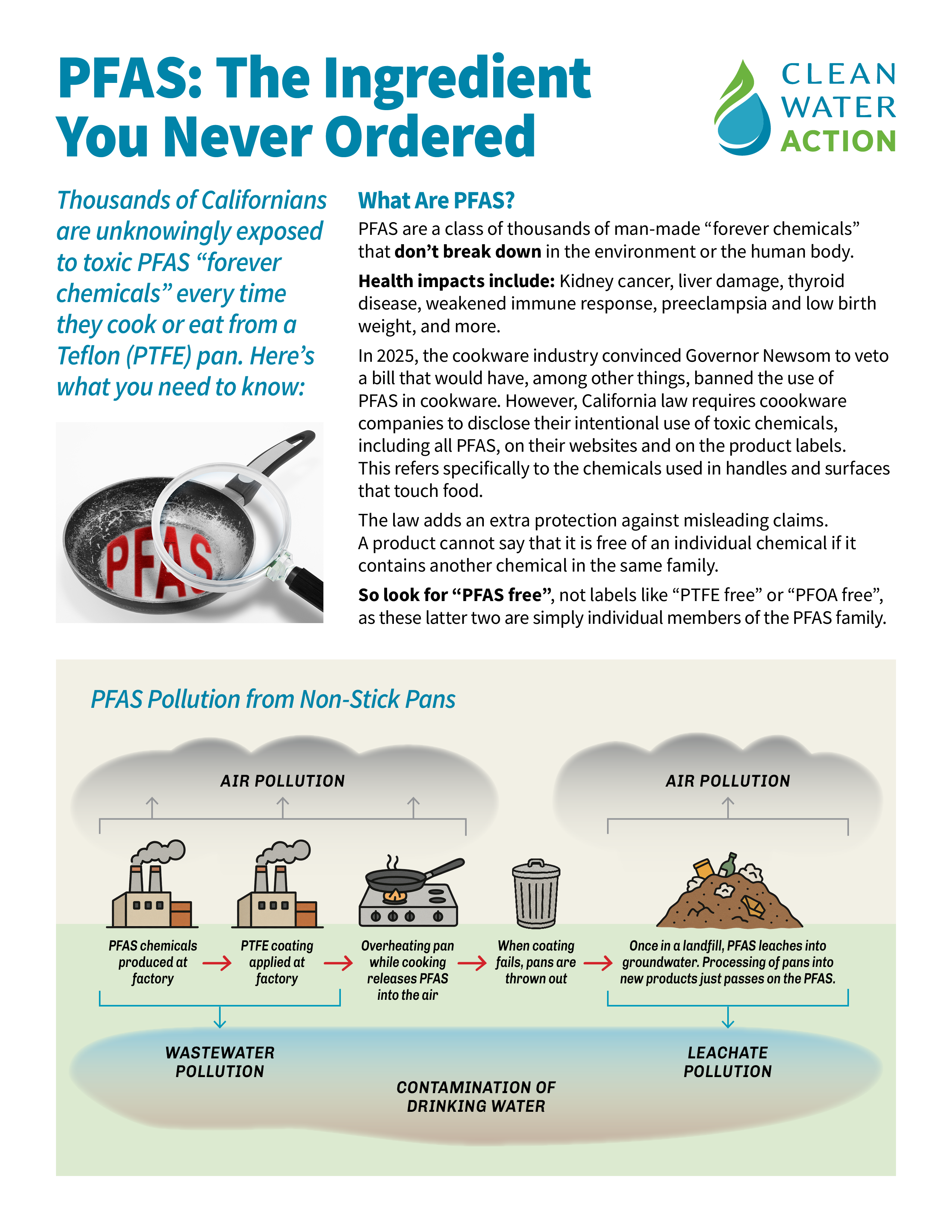
Thousands of Californians are unknowingly exposed to toxic PFAS “forever chemicals” every time they cook or eat from a Teflon (PTFE) pan. Here’s what you need to know:
What Are PFAS?
PFAS are a class of thousands of man-made “forever chemicals” that don’t break down in the environment or the human body. Health impacts include: Kidney cancer, liver damage, thyroid disease, weakened immune response, preeclampsia and low birth weight, and more.
In 2025, the cookware industry convinced Governor Newsom to veto a bill that would have, among other things, banned the use of PFAS in cookware. However, California law requires cookware companies to disclose their intentional use of toxic chemicals, including all PFAS, on their website and on the product labels. This refers specifically to the chemicals used in handles and surfaces that touch food.
The law adds an extra protection against misleading claims. A product cannot say that it is free of an individual chemical if it contains another chemical in the same family.
So look for "PFAS free", not labels like "PTFE fee" or "PFOA free", as these latter two are simply members of the PFAS family.
Industry Pressure
While some states have already banned PFAS in cookware, the industry has launched a major campaign to weaken those laws and prevent others from being passed. But the facts are clear:
- Safer, PFAS-free cookware already exists — including stainless steel, ceramic nonstick, carbon steel, and cast iron.
- Many brands already make PFAS-free lines while still lobbying against reform through the Sustainable Cookware Alliance.
- FDA approval ≠ safety. The FDA’s outdated chemical review process allows PFAS in food-contact materials without sufficient testing.
- PTFE in pacemakers ≠ PTFE in pans. One saves lives; the other is a convenience — and we have safer options.
The Cost of Doing Nothing
- PFAS have been found in drinking water sources of 25 million Californians.1
- According to an analysis by scientists at the Natural Resources Defense Council, the cost of remediating California's current levels of just two PFAS chemicals in drinking water is between $161-217 million dollars per year.2
What You Need to Know About Nonstick Cookware
- PTFE (used in Teflon) is a plastic PFAS chemical.3
- PTFE coatings flake, scratch, and degrade — releasing microplastics that carry PFAS into your food.4,5,6
- PTFE microplastics have been found in urine and semen and are linked to reduced sperm counts.6
- Heated PTFE pans release toxic fumes:
— Pet birds can die from exposure at just 326°F.7
— Humans experience “Teflon Flu” — flu-like symptoms after inhaling fumes.
— The Washington Post reported 267 cases in 2024 alone.
Californians Have a Choice:
Six states have passed laws banning PFAS in cookware: Colorado, Connecticut, Maine, Minnesota, Rhode Island, and Vermont.8
Despite the Governor's veto, Californians can still protect themselves and the environment by saying NO to Teflon, PTFE, or other PFAS when buying cookware.
Safer alternatives, such as stainless steel, glass, cast iron, and ceramic, not only exist but can be comparable in price. In fact, in many cases the companies that make the PFAS cookware also make and sell these alternatives as well.
Protect California's water. Protect your family. Say NO to toxic cookware.
- https://www.waterboards.ca.gov/pfas/drinking_water.html
- https://www.nrdc.org/media/social-burden-pfas-forever-chemicals-california#cost-estimates
- https://www.epa.gov/system/files/documents/2023-03/GenX-Toxicity-Assessment-factsheet-March-2023-update.pdf
- https://www.sciencedirect.com/science/article/abs/pii/S004896972205392X
- https://pubs.acs.org/doi/10.1021/acs.est.3c09524
- https://www.news-medical.net/news/20241001/Study-finds-microplastics-in-semen-and-urine-linking-PTFE-exposure-to-lower-sperm-count.aspx
- https://www.teflon.com/en/consumers/teflon-coatings-cookware-bakeware/safety/bird-safety
- https://www.saferstates.org/resource/state-action-on-pfas