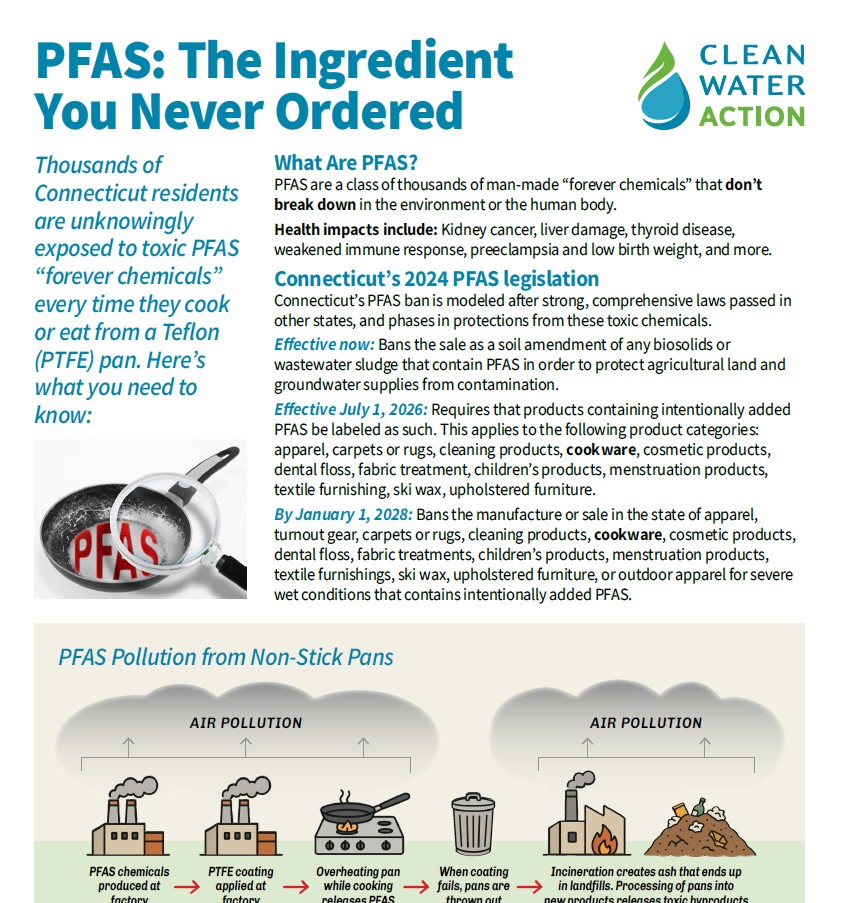
Thousands of Connecticut residents are unknowingly exposed to toxic PFAS “forever chemicals” every time they cook or eat from a Teflon (PTFE) pan. Here’s what you need to know:
What Are PFAS?
PFAS are a class of thousands of man-made “forever chemicals” that don’t break down in the environment or the human body. Health impacts include: Kidney cancer, liver damage, thyroid disease, weakened immune response, preeclampsia and low birth weight, and more.
Connecticut’s 2024 PFAS legislation
Connecticut’s PFAS ban is modeled after strong, comprehensive laws passed in other states, and phases in protections from these toxic chemicals.
Effective now: Bans the sale as a soil amendment of any biosolids or wastewater sludge that contain PFAS in order to protect agricultural land and groundwater supplies from contamination.
Effective July 1, 2026: Requires that products containing intentionally added PFAS be labeled as such. This applies to the following product categories: apparel, carpets or rugs, cleaning products, cookware, cosmetic products, dental floss, fabric treatment, children’s products, menstruation products, textile furnishing, ski wax, upholstered furniture.
By January 1, 2028: Bans the manufacture or sale in the state of apparel, turnout gear, carpets or rugs, cleaning products, cookware, cosmetic products, dental floss, fabric treatments, children’s products, menstruation products, textile furnishings, ski wax, upholstered furniture, or outdoor apparel for severe wet conditions that contains intentionally added PFAS.
Industry Pressure
The cookware and chemical industries are working to weaken PFAS laws across the country and exempt cookware from PFAS restrictions. But the facts are clear:
- Safer, PFAS-free cookware already exists — including stainless steel, ceramic nonstick, carbon steel, and cast iron.
- Many brands already make PFAS-free lines while still lobbying against reform through the Sustainable Cookware Alliance.
- FDA approval ≠ safety. The FDA’s outdated chemical review process allows PFAS in food-contact materials without sufficient testing.
- PTFE in pacemakers ≠ PTFE in pans. One saves lives; the other is a convenience — and we have safer options.
The Cost of Doing Nothing
- Cleaning PFAS from wastewater and biosolids is expensive, and the cost is passed to municipalities.
- PFAS costs $50–$1,000 per pound to buy, but $2.7–$18 million per pound to remove and destroy.
- PFAS-related health costs in the U.S. are estimated at $37–59 billion annually.1
What You Need to Know About Nonstick Cookware
- PTFE (used in Teflon) is a plastic PFAS.2
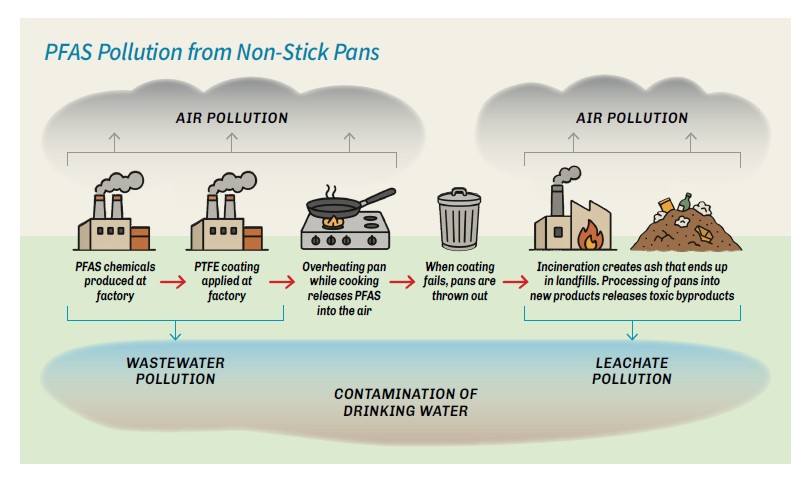
- PTFE coatings flake, scratch, and degrade — releasing microplastics that carry PFAS into your food.3,4,5
- PTFE microplastics have been found in urine and semen and are linked to reduced sperm counts.5
- Heated PTFE pans release toxic fumes:
— Pet birds can die from exposure at just 326°F.6
— Humans experience “Teflon Flu” — flu-like symptoms after inhaling fumes.
— The Washington Post reported 267 cases in 2024 alone.
We must protect CT’s PFAS ban
Connecticut’s 2024 law is part of a nationwide movement of states restricting toxic chemicals in the face of federal indifference. PFAS can contaminate waterways and drinking water in the communities where they are produced and disposed of, and they certainly don’t belong in the products we use to cook our food.
Protect Connecticut families. Say NO to toxic cookware.
- https://pmc.ncbi.nlm.nih.gov/articles/PMC8296683/
- https://www.epa.gov/system/files/documents/2023-03/GenX-Toxicity-Assessment-factsheet-March-2023-update.pdf
- https://www.sciencedirect.com/science/article/abs/pii/S004896972205392X
- https://pubs.acs.org/doi/10.1021/acs.est.3c09524
- https://www.news-medical.net/news/20241001/Study-finds-microplastics-in-semen-and-urine-linking-PTFE-exposure-to-lower-sperm-count.aspx
- https://www.teflon.com/en/consumers/teflon-coatings-cookware-bakeware/safety/bird-safety