This paper examines how weakening Clean Water Act oil and gas wastewater pollution limits would threaten drinking water. It outlines the known risks associated with this harmful wastewater, highlights impacts to downstream drinking water, and identifies the significant knowledge gaps that remain. Overall, EPA should be strengthening, not weakening, wastewater discharge standards for the oil and gas industry to better protect drinking water sources and surrounding communities.
Introduction
The United States is producing more oil and gas than ever before and continues to be the world’s top producer of crude oil and natural gas. The Trump administration’s unprecedented push to produce more oil and gas indicates there is no slowing down any time soon. As exploration and production activities continue to soar, the oil and gas industry is seeking easier and cheaper ways to dispose of its toxic wastewater by pushing for regulatory changes under the Clean Water Act.
In most cases, the Clean Water Act prohibits the direct discharge of wastewater from oil and gas facilities. However, the Clean Water Act includes an unnecessary exception that allows the harmful wastewater generated from oil and gas drilling (known as produced water) to be reused in limited ways in the west for certain agricultural uses, like watering of livestock and crop irrigation, or wildlife propagation. There have been substantial changes to the oil and gas industry since this exception was promulgated almost 50 years ago, in 1979. This outdated exception does not account for current extraction techniques, new chemicals used in the process, or advancements in treatment technologies.
In 2025, the Environmental Protection Agency (EPA) announced plans to expand this exception by allowing this harmful wastewater stream to be discharged in more places and reused for more purposes. Weakening limits on oil and gas wastewater discharge is reckless given the lack of understanding of pollutants present in the wastewater stream and potential risks to downstream water quality and drinking water safety. Until produced water is fully characterized, its risks to downstream drinking water and public health are better understood, and effective treatment methodologies have been identified, EPA should not consider expanding this exception.
The Putting Drinking Water First initiative is rooted in a simple idea: when policymakers focus on reducing impacts to drinking water at the heart of their decision-making, a wide range of environmental, public health, economic, and local community benefits follow. When it comes to oil and gas wastewater discharge, this means strengthening, not weakening, the wastewater discharge standards for the oil and gas industry to protect drinking water sources and better protect the public.
The United States is Producing More Oil than Any Time in History
The U.S. Energy Information Administration (EIA) reported that the United States produced more oil than any nation in the world for six years in a row, averaging 12.9 million barrels per day in 2023.1 Record levels of oil production were forecasted through 2026.2 Advancements in drilling technologies (including horizontal drilling, hydraulic fracturing (fracking), and enhanced oil recovery) have made it easier and more economically viable to extract oil and gas from previously inaccessible areas. These technologies have boosted extraction in many parts of the country, especially in regions like the Permian Basin located across Texas and New Mexico.3,4
Produced Water Contains Known Hazardous Pollutants
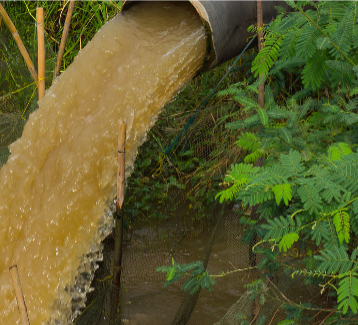
Oil and gas activities generate a significant amount of waste — the largest of which is known as “produced water.”5 Produced water broadly refers to the fluids that come to the surface during oil and gas production. Most produced water is disposed into underground injections wells. But the oil and gas industry has shown increasing interest in discharging this toxic wastewater stream into surface waters protected under the Clean Water Act.
Produced water contains chemicals that have been injected into the well during the oil extraction process as well as constituents that are naturally present in these underground geologic formations. The composition of produced water varies significantly depending on numerous factors such as geographic location, depth of the well, extraction techniques, and the chemical additives used during the process. Produced water typically includes a mix of naturally occurring constituents like salts (or total dissolved solids (TDS)), heavy metals, and even radioactive materials like NORM (naturally occurring radioactive material) and TENORM (technologically enhanced naturally occurring radioactive material.6,7 These naturally occurring constituents interact with chemicals added during the extraction process, leading to additional chemical mixtures and transformation products.
Studies have found more than 1,100 unique chemicals in produced water, many with known health risks.8 Various heavy metals known to harm health are present in produced water, including arsenic, cadmium, lead, and mercury.9 Radioactive materials have also been found in produced water and have been linked to increased cancer risk.10 One study, examining more than 800 hydraulically fractured wells in California, found that 96% of produce water contained hazardous and toxic compounds, some posing serious health risks.11 Another study found that 1,200 oil and gas wells across six states use per- and polyfluoroalkyl substances (PFAS).12 PFAS are a significant public health threat with links to cancer, developmental delays, and higher-risk pregnancies.
Produced Water Has Been Found to Directly Impact Downstream Drinking Water
Many of the constituents in produced water present problems in drinking water. In multiple studies, EPA has documented the presence of measurable amounts of contaminants found in produced water downstream even when produced water is treated using conventional methods before being discharged. For example, levels of TDS, bromide, chloride, metals, and radioactive materials found downstream from oil and gas facilities exceeded the thresholds recommended for protecting human health and aquatic ecosystems.13
In a 2016 study on the impacts of hydraulic fracturing activities, EPA found that inadequate treatment of produced water from hydraulic fracturing activities can impact drinking water resources.14 One example in Pennsylvania’s Marcellus Shale region showed that wastewater treatment facilities were unable to remove the high levels of salts found in produced water, especially bromide.15
Bromide, often found in produced water, is a good example of the health risks, treatment challenges, and operational complications that contaminants in produced water can pose for drinking water systems. Water containing elevated concentrations of bromide can interact with chemicals used in the treatment process, resulting in formation of disinfection byproducts linked to cancer and other health impacts. EPA’s 2016 study linked elevated levels of bromide to an increase in disinfection byproducts in at least one downstream drinking water facility.16
Growing concern about brominated disinfection byproducts is reflected in their presence in key Safe Drinking Water Act implementation lists, including the Contaminant Candidate List and the Unregulated Contaminant Monitoring Rule List.17,18 This indicates that among the wide universe of potential chemicals and microbial contaminants that may merit consideration for regulation, bromide and the disinfection byproducts it can form have been elevated for particular attention. Limiting bromide discharges can reduce the formation of harmful byproducts and the treatment burden placed on downstream water systems.
Major Knowledge Gaps Make It Impossible to Fully Understand the Composition and Harms of Produced Water
A major complicating factor in understanding the composition of produced water is lack of transparency. The oil and gas industry is not required to fully disclose all the chemicals in produced water. Many of the chemicals are hidden due to “trade secret” claims and the proprietary nature of formulations. There are also no ways to reliably test for the constituents present in produced water, and little is known about toxicity and the effectiveness of treatment methodologies.
Recent studies and reports underscore significant knowledge gaps regarding produced water. In 2019, EPA conducted a study evaluating the management of produce water. Many stakeholders, including environmental and public health organizations, academia, and government associations, raised concerns surrounding the lack of available data on chemicals in produced water and its effective treatment methods.19 A 2020 study found that 86% of chemicals in produced water do not have toxicity data to conduct a risk assessment, and only 24% can be detected using standard methods.20
A Groundwater Protection Council report also stressed that, in order to avoid unintended consequences of the reuse of produced water outside oil and gas operations, further research is needed to better understand the chemical characterization of produced water, toxicity and risk, monitoring methods, and the effectiveness of treatment technologies.21 Researchers from the United States Geological Survey and Health Effects Institute Energy identified major knowledge gaps needed to assess human health risks from produced water exposure, including limited data on its chemical composition, detection methodologies, documentation of releases, and effectiveness of treatment methods.22 The Colorado Produced Water Consortium released a report in July 2025 again highlighting the need for complete characterization of produced water, increased toxicological data, and improved treatment technologies.23 Overall, these major knowledge gaps make it impossible to fully understand the risks associated with produced water.
Despite these Known Harms and Knowledge Gaps, EPA is Considering Weakening Discharge Limits for Produced Water
Although the Clean Water Act prohibits the direct discharge of produced water in most cases, it has included a loophole for certain uses in the West since 1979. Under the Clean Water Act’s Effluent Limitation Guidelines (ELGs) for the oil and gas industry, the Agricultural and Wildlife Water Use Subcategory allows onshore oil and gas facilities located west of the 98th meridian to discharge produced water to surface waters. Under this exception, produced water must be of “good enough quality,” have a beneficial reuse in agriculture or wildlife propagation when discharged into navigable waters, and adhere to a daily maximum limitation of 35 mg/L for oil and grease by the application of the best practicable control technology.24 For years, Clean Water Action and Clean Water Fund have advocated for this unnecessary exception to be closed.25,26
In March 2025, EPA announced plans to reconsider the wastewater regulations for the oil and gas industry as part of its sweeping announcement to rollback 31 critical regulations.27 EPA expressed interest in expanding the geographic area where produced water is allowed to be discharged, potentially including areas on the eastern side of the country. EPA is also exploring the use of produced water for additional purposes, including Artificial Intelligence data center cooling, rangeland irrigation, fire control, and power generation.28 EPA has also announced that it completed a study on the Agricultural and Wildlife Water Use Subcategory; however, the study has yet to be published.29
EPA Should Strengthen, Not Weaken, Oil and Gas Wastewater Discharge Standards
At a time when oil and gas production is booming and the industry is looking for easier ways to dispose of its growing volumes of toxic wastewater, EPA should not be loosening oil and gas wastewater discharge standards.
EPA must consider the growing number of concerns surrounding the harmful chemicals in produced water. Just to name a few, produced water contains harmful heavy metals, high levels of bromide, radioactive materials, and PFAS. Studies have shown that this toxic waste stream has impacted downstream drinking water sources. At the same time, major gaps remain, including uncertainty regarding the full chemical composition of produced water, insufficient data on toxicity and risk, and limited understanding of the effectiveness of treatment methods. These significant knowledge gaps make it impossible to understand the full breadth of risks to downstream water quality and drinking water safety.
Given these uncertainties, EPA should strengthen, not weaken, wastewater discharge standards for the oil and gas industry. EPA should:
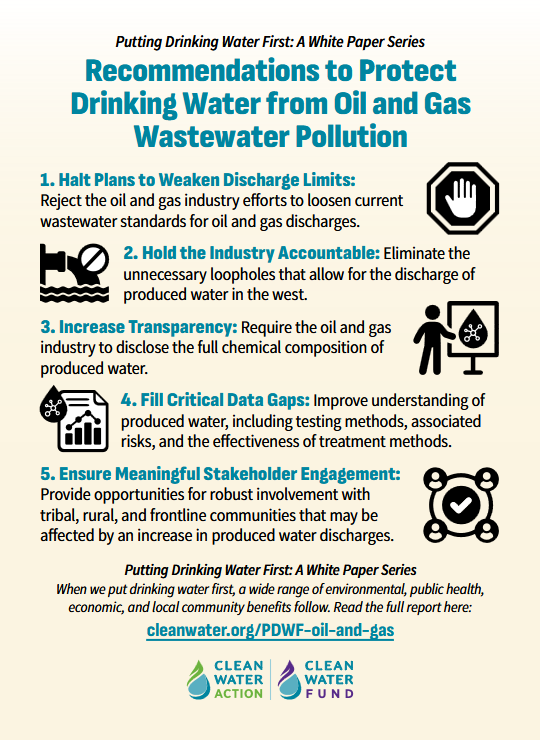
- Halt Any Plans to Weaken Oil and Gas Discharge Limits: Reject the oil and gas industry efforts to loosen current wastewater standards for oil and gas discharges.
- Hold the Industry Accountable: Eliminate the unnecessary loopholes that allow for the discharge of produced water in the west.
- Increase Transparency: Require the oil and gas industry to disclose the full chemical composition of produced water.
- Fill Critical Data Gaps: Improve understanding of produced water, including testing methods, associated risks, and the effectiveness of treatment methods.
- Ensure Meaningful Stakeholder Engagement: Provide opportunities for robust involvement with tribal, rural, and frontline communities that may be affected by an increase in produced water discharges.
Conclusion
To uphold its mission to protect public health and the environment, EPA must hold the oil and gas industry accountable for its toxic wastewater stream and close the current loopholes that allow for the discharge of produced water in the west. EPA has no justification for expanding the discharge of oil and gas produced water in more areas of the country. Doing so would increase harmful pollution, putting the safety of nearby communities and our drinking water sources at risk.
Putting Drinking Water First not only results in drinking water protection but leads to better choices which can prevent other environmental impacts and avoid costly downstream treatment. Weakening Clean Water Act limits on oil and gas wastewater discharge would be a reckless giveaway to the industry. Given the known hazardous pollutants in produced water, the documented impacts to downstream drinking water, and the significant knowledge gaps that remain, EPA should prohibit the discharge of produced water across the country. Strengthening wastewater discharge standards for the oil and gas industry will better safeguard drinking water sources, while also protecting the environment, public health, and surrounding communities.
- U.S. Energy Information Administration, “United States produces more crude oil than any country, ever” March 11, 2024. https://www.eia.gov/todayinenergy/detail.php?id=61545
- U.S. Energy Information Administration, “EIA forecasts near-term U.S. crude oil production will remain near 2025 record,” January 22, 2026.
https://www.eia.gov/todayinenergy/detail.php?id=67045 - U.S. Energy Information Administration, Texas State Profile. https://www.eia.gov/state/?sid=TX#:~:text=Quick%20Facts,its%20natural%20
gas%20gross%20withdrawals - U.S. Energy Information Administration, New Mexico State Profile. https://www.eia.gov/state/?sid=NM
- EPA, Office of Water (2020). Summary of Input on Oil and Gas Extraction Wastewater Management Practices Under the Clean Water Act, EPA- 821-S19-001. https://www.epa.gov/sites/default/files/2020-05/documents/oil-gas-final-report-2020.pdf
- Groundwater Protection Council (2019), Produced Water Report, https://www.gwpc.org/wp-content/uploads/2019/06/Produced_Water_Full_Report___Digital_Use.pdf
- Colorado Produced Water Consortium (2025), “Analytical and Toxicological Methods and Evaluation Tools for Produced Water Treatment and Potential Use Outside of the Oilfield” https://drive.google.com/file/d/1mRCJxvOzJsrPwwh3C92PZTTazGpcFfhq/view
- Danforth, C., Chiu, W. A., Rusyn, I., Schultz, K., Bolden, A., Kwiatkowski, C., & Craft, E. (2020). “An integrative method for identification and prioritization of constituents of concern in produced water from onshore oil and gas extraction”. Environment International, 134, 105280.
- Sun, Yuqing, et al. (2019) “A critical review of risks, characteristics, and treatment strategies for potentially toxic elements in wastewater from shale gas extraction” https://www.sciencedirect.com/science/article/pii/S0160412018322487?via%3Dihub#bb0200
- NRDC (2021). A Hot Fracking Mess: House Weak Regulation of Oil and Gas Production Leads to Radioactive Waste in our Water, Air, and Communities, https://www.nrdc.org/sites/default/files/fracking-mess-regulation-radioactive-waste-report.pdf
- Chittick, E. A. , & Srebotnjak, T. (2017). An analysis of chemicals and other constituents found in produced water from hydraulically fractured wells in California and the challenges for wastewater management. https://www.sciencedirect.com/science/article/abs/pii/S0301479717308630?via%3Dihub
- Horwitt, Dusty (2021). Physicians for Social Responsibility, Fracking with “Forever Chemicals” https://psr.org/wp-content/uploads/2021/07/ fracking-with-forever-chemicals.pdf
- EPA (2018). Detailed Study of the Centralized Waste Treatment Point Source Category for Facilities Managing Oil and Gas Extraction Wastes EPA821-R-18-004. https://www.epa.gov/sites/default/files/2018-05/documents/cwt-study_may-2018.pdf
- EPA (2016). Hydraulic Fracturing For Oil And Gas: Impacts From The Hydraulic Fracturing Water Cycle On Drinking Water Resources In The United States (Final Report). https://cfpub.epa.gov/ncea/risk/recordisplay.cfm?deid=332990
- Ibid.
- Ibid.
- EPA, Drinking Water Contaminant List 6- Draft. https://www.federalregister.gov/documents/2026/04/06/2026-06662/drinking-water-contaminant-candidate-list-6-draft
- EPA, UCMR4, https://www.epa.gov/dwucmr/archival-data-finder-unregulated-contaminant-monitoring-rule-ucmr-1-4
- EPA, Office of Water. (2019) Draft Study of Oil and Gas Extraction Wastewater Management Under the Clean Water Act EPA-821-R19-001
- Danforth, C., Chiu, W. A., Rusyn, I., Schultz, K., Bolden, A., Kwiatkowski, C., & Craft, E. (2020), An integrative method for identification and prioritization of constituents of concern in produced water from onshore oil and gas extraction. Environment International, 134, 105280. https://doi.org/10.1016/j.envint.2019.105280
- Groundwater Protection Council (2019). Produced Water Report: Regulations, Current Practices, and Research Needs https://www.gwpc.org/wp-content/uploads/2019/06/Produced_Water_Full_Report___Digital_Use.pdf
- Ariana, Ayusha et al. (2025) “Pathways for Potential Exposure to Onshore Oil and Gas Wastewater: What We Need to Know to Protect Human Health” https://pmc.ncbi.nlm.nih.gov/articles/PMC11966568/#gh270015-sup-0001
- Colorado Produced Water Consortium (2025), “Analytical and Toxicological Methods and Evaluation Tools for Produced Water Treatment and Potential Use Outside of the Oilfield” https://drive.google.com/file/d/1mRCJxvOzJsrPwwh3C92PZTTazGpcFfhq/view
- 40 CFR § 435 Subpart E
- Clean Water Action and Clean Water Fund. “Clean Water Act Regulation of Oil and Gas Wastewater Discharges: A Call for Improved Oversight and Transparency” (January 2020). https://cleanwater.org/publications/report-clean-water-act-regulation-oil-and-gas-wastewater-discharges
- Clean Water Action and Clean Water Fund. “The Roadmap for Reform Federal and State Action Needed to Protect Water from Upstream Oil and Gas Activities” (March 2021). https://cleanwater.org/publications/roadmap-reform
- EPA (March 12, 2025). “EPA Will Revise Wastewater Regulations for Oil and Gas Extraction to Help Unleash American Energy (ELGs: Oil and Gas)”.
https://www.epa.gov/newsreleases/epa-will-revise-wastewater-regulations-oil-and-gas-extraction-help-unleash-american - Ibid.
- EPA, “Oil and Gas Extraction Effluent Guidelines” https://www.epa.gov/eg/oil-and-gas-extraction-effluent-guidelines (Accessed August 7, 2026).